[ad_1]
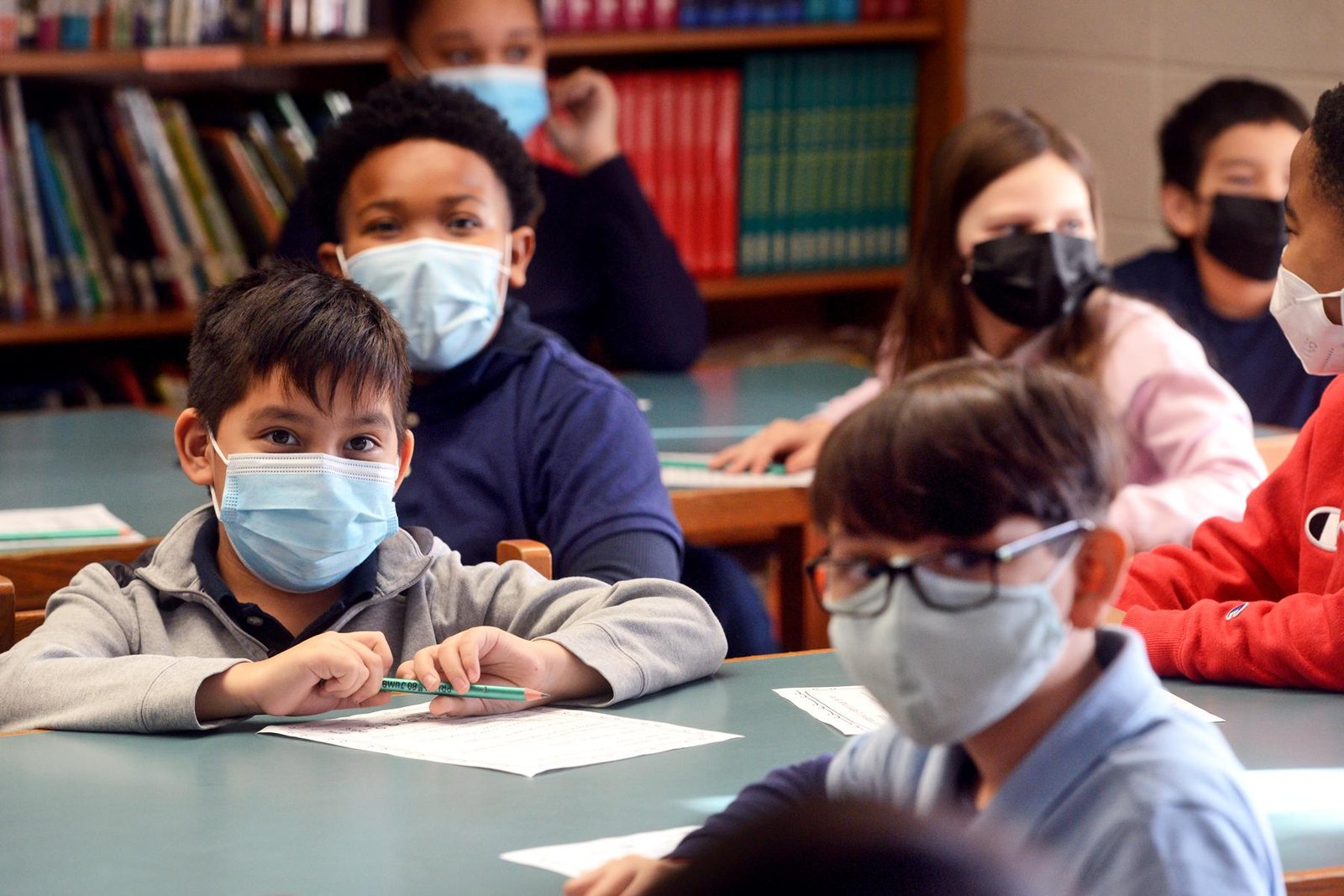
Gov. Ned Lamont hinted that a change could be coming to the state’s school mask mandate when he said Tuesday that he is watching the numbers closely over the next few days before deciding.
“I am going to wait to take a look at the metrics,” Lamont said. “I think we see what the trend is going forward. … I think we will have a lot of clarity over the next few days, over the next week, and if the metrics say it’s time for a change, we will make a change.”
Lamont said he was considering lifting the school mask mandate and giving local school boards the option to institute their own policies like he has with municipalities.
“I think that’s a real possibility,” Lamont said.
“We know that there’s another variant out there, but also I think we now know how to manage through these little mini-surges,” he added.
While Connecticut continues to see COVID-19 metrics much higher than the start of the academic year in September, a recent surge brought on by the omicron variant appears to be waning.
On Tuesday, the positivity rate was 8.68 percent — a slight uptick from what was reported through the weekend — with 1,240 new COVID-19 cases found in 14,293 tests.
Hospitalizations, another metric that spiked significantly during the omicron wave, dropped by a net of 56 patients for a total of 995, the first time it was below 1,000 total patients since Dec. 28.
Lamont said Tuesday the state and its residents are better at managing spikes in COVID-19 infections and reiterated the tools for individuals to keep themselves safe.
Lamont’s remarks come about two weeks before his emergency powers are set to expire, along with all the executive orders issued during the pandemic. However, the ability for the state’s education department to require masks in schools was among a list of 11 executive orders he asked the legislature to keep in place once his powers expire.
When asked if students and teachers should continue to wear masks, Dr Ulysses Wu, chief epidemiologist for Hartford HealthCare, pointed to the science that shows masks work.
“It will be dependent on school districts. It will be dependent on the tenor in that district. Looking at the science standpoint, masks work. Whether it’s worth getting rid of those mask mandates, it remains to be seen,” Wu said.
Dr. Juan Salazar, physician-in-chief for Connecticut Children’s Medical Center, said it might be premature to lift the mask requirements in schools.
“We have to follow the epidemiology. I think the positivity rate is too high and we have too much virus out there still with a very susceptible population, especially with 5- to 11-year-olds where the fully vaccinated is not much more than 40 percent,” Salazar said.
While Lamont continues to weigh the future of masks in schools, Pfizer-BioNTech requested Tuesday an emergency authorization from the Food and Drug Administration for use of its COVID-19 vaccine on children ages 6 months to 4 years old.
The move was met with some optimism from Connecticut health experts, who had yet to see any data from Pfizer-BioNTech.
“It’s been long overdue that we get a product, a vaccine, that can be used in that specific age group. It’s the one that remains unvaccinated and we were hoping this had occurred six months ago,” Salazar said. “It does appear now that they have enough data suggesting that it is safe … and efficacious.”
Dr. Thomas Murray, associate director for infection prevention at Yale New Haven Children’s Hospital, said he also has not yet seen the data.
“If that information looks good, as it has with other age groups, this is another opportunity to protect a vulnerable population from severe infection,” he said.
While Pfizer-BioNTech has been studying the use of COVID-19 vaccines in this age group for some time, Wu said it does not mean parents should hesitate to get young children vaccinated.
“The vaccines are safe, they aren’t awaiting additional data to see if it’s safe for everybody, they are waiting for additional data to ensure it stimulates the immunoresponse they are looking for,” he said.
While cases and hospitalizations surged overall in January, both children’s hospitals similarly saw a sharp uptick of pediatric COVID-19 cases during the recent omicron wave.
“We’ve had a huge increase in the number of children admitted with COVID-19 over the last month, specifically and unfortunately, in this age group (6 months to 4 years old),” Murray said.
However, the jump in pediatric cases appears to have followed a similar trajectory to what was seen with COVID-19 metrics overall.
“I think we are past the peak and we are hopeful this will bring us to a better March and April,” Salazar said.
Staff writer Ken Dixon contributed to this story.
[ad_2]
Source link