[ad_1]
The Oregon Health Authority (OHA) was expected to file permanent rules Friday that keeps in place requirements for masking indoors in K-12 schools, and requirements for school and school-based program staff to be vaccinated.
State health officials emphasized that the rule filing will maintain masking protections during the current Omicron surge. State officials are developing measures to determine when it may be safe to lift the school mask rule.
The permanent rules replace temporary rules, which are only valid for 180 days, that are set to expire today.
Also expected to be filed Monday are permanent rules requiring health care workers to wear masks, and for health care workers in most health care settings to be fully vaccinated.
State health officials continue to review public comments on a proposed permanent rule that would continue, for now, the requirement that masks be worn in indoor public places. That temporary rule expires Feb. 8.
At a news conference Friday, Dean Sidelinger, M.D., M.S.Ed., state health officer and state epidemiologist, said that while the rules are permanent, OHA can loosen or rescind them as conditions with the pandemic change, particularly with hospitalizations.
“We need to look at the number of COVID-19-positive folks in the hospital who are receiving care and the impact on the ability of the hospitals to provide care,” he said. “What we know right now is that those numbers are still increasing but are anticipated to peak soon – within the next week to week and a half – and then are anticipated to come down rather quickly.”
Sidelinger added that the drop in hospitalizations is likely to happen quicker than during the Delta surge in fall 2021, as the length of stay and the amount of critical care needed for patients is less.
“So I would anticipate, in the coming weeks to month and a half, that we will see a significant decrease in the number of people with COVID in the hospital,” he said, “and at that time it’ll be a time to start talking about ‘Can we move from a requirement for masks in indoor public spaces to a recommendation for certain populations or in certain communities where rates are higher?’”
Sidelinger also said that actions people in Oregon take over the next several weeks will be critical to ensuring the state’s hospitals have enough capacity to meet the needs of all patients needing care. That means getting primary and booster vaccines, continuing to wear masks indoors and in crowded outdoor spaces, keeping gatherings small and staying home if you are sick or if you test positive.
“It also means extending protective measures that were enacted earlier in the pandemic requiring mask wearing in schools and health care settings, and requiring vaccinations for school employees and health care workers and wearing masks in indoor settings,” he said.
Oregon administrative rules expected to be filed Friday, Jan. 28 with the Oregon Secretary of State’s Office:
OAR 333-019-1015 – Masking Requirements in Schools.
OAR 333-019-1030 – COVID-19 Vaccination Requirements for Teachers and School Staff.
Rules expected to be filed on Jan. 31 include:
OAR 333-019-1010 – COVID-19 Vaccination Requirement for Healthcare Providers and Healthcare Staff in Healthcare Settings.
OAR 333-019-1011 – Masking Requirements to Control COVID-19 in Health Care Settings.
Filing of the permanent rules follows a public comment period that began Dec. 10 and ended Jan. 24. Written comments were accepted, and there were three public hearings – one on Jan. 20 that covered the indoor spaces masking rule, and two on Jan. 24 for the school masking and vaccination rules, and health care settings masking and vaccination rules.
The decision to make Oregon’s indoor mask mandate indefinite was pending as of Friday, Jan. 28.
Oregon’s hearing on a proposed permanent mask rule drew a crowd of more than 300 people, opening the floodgates to a wide range of comments and emotions.

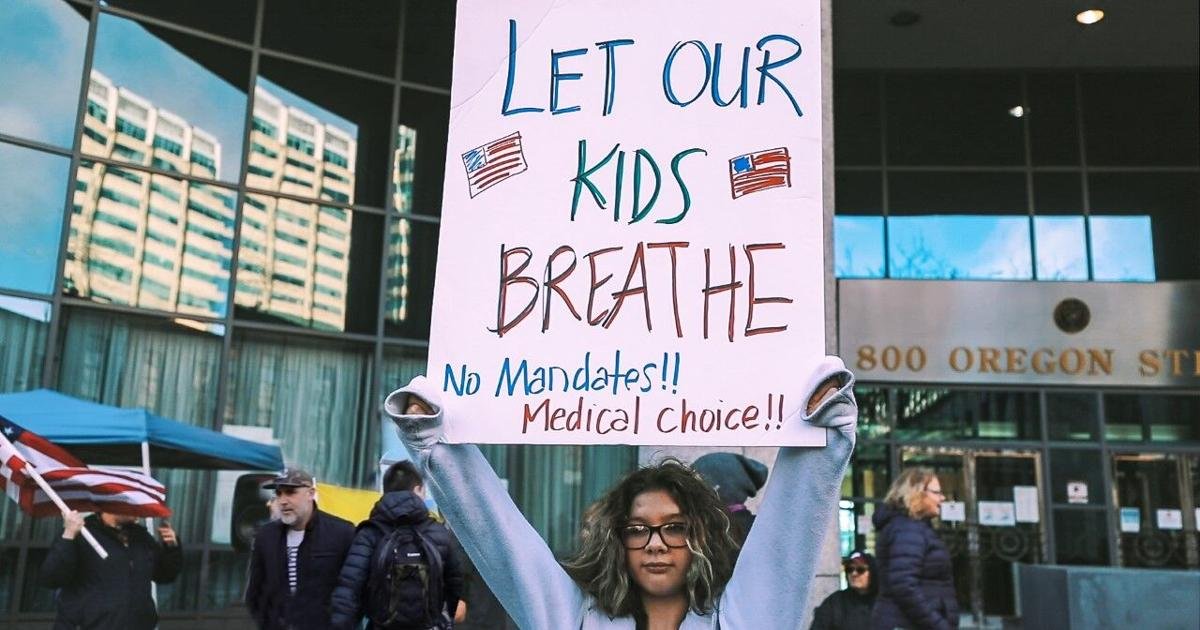
A Free Oregon demonstrator holds up a sign to voice her opposition to the proposed permanent mask rule during the Jan. 20 protest at the Oregon Health Authority office in Portland.

Free Oregon protestors toss their face coverings into a lit barrel during the protest outside the Oregon Health Authority office in Portland.
The Oregon Health Authority (OHA) held the public electronic hearing Jan. 20 on the proposed rule change, inviting public testimony on which a decision has yet to be determined.
One woman struggled to hold back sobs during her testimony, as she described the moment her 8-year-old told her she couldn’t remember what the world was like without masks.
Another speaker said he has 40% of a healthy person’s lung capacity and thus has difficulty breathing with a mask on.
“Free these childrens’ faces so they can smile again,” a third said, his voice filled with emotion.
Others took on radically different tones, threatening to take action if the OHA goes through with imposing the new permanent rule.
“If you do this, we will fight to our death,” Nikolas, a defense attorney representing a client who violated Oregon’s current temporary mask mandate, said. “The farther you take this, the farther we will take it. We have nothing to lose.”
“We’re coming for you. We’re coming for your jobs,” Free Oregon Leader Angela Todd said.
Demonstrators involved with Free Oregon, a grassroots organization dedicated to upholding the mission of “fighting tyranny” in Oregon, took to the streets, holding a “BBQ Mask Party” outside the OHA office at NE 800 Oregon Street in Portland.
“Bring a mask and something to burn,” the event description read on the Free Oregon website.
Demonstrators chanted, held signs, and set a barrel containing surgical masks ablaze in synchronicity with the OHA’s electronic hearing, which kicked off at 10 a.m. and lasted for several hours.
Administrative Rules Coordinator Brittany Hall led the OHA’s Administrative Rules hearing, discussing the adoption of a permanent rule requiring masks to be worn in indoor spaces in Oregon.
Hall opened the meeting with the following clarifying statement.
“The temporary rule cannot be extended past six months, thus Oregon’s temporary rule expires on Feb. 8,” she said. “That does not mean the rule is permanent. The Oregon Health Authority can rescind, repeal, or cancel a rule when it decides it is no longer necessary.”
After opening remarks, Hall invited testifying members of the public to speak.
Opponents of the proposed permanent rule presented concerns ranging from realized sociological harms to the sole authority such a rule will give the agency, creating obstacles for the public to seek legal recourse.
Aden Nepom, the meeting’s first speaker, expressed concern that the OHA’s proposal would bypass public input, concluding with a statement affirming the importance of local decision-making.
“Allow small businesses (and) school districts to make the masking decisions that make the most sense in their specific communities and circumstances so that we can stop trying to stop COVID, which is a fool’s errand, and begin trying to figure out how to move forward,” she said.
Matt Runkle, another guest speaker, put forth numerous arguments calling the logic of permanent masking into question, including a lack of sufficient evidence for mask efficacy, disproportionate impacts on essential workers, and the potential of lasting effects on a generation.
“Their (children’s) anger will be very justified,” he said.
Runkle also pointed out that 42 out of 50 states have repealed mask mandates, despite news of the Omicron variant, and highlighted there are “no discernable differences” between states such as Florida, which banned mask mandates in public schools, and Oregon, in terms of high case rates, hospitalizations, and deaths.
Runkle underscored the inequitable outcomes of such a rule change, arguing that school children and frontline workers, required to mask up for 8 hours a day, will inordinately pay the price.
Others present at the meeting, in their condemnation of the OHA’s proposal, expressed their willingness to fight against the rule.
“I think it’s pretty clear that the public does not trust you anymore,” Portland resident Elizabeth Moore said.
Public health perspective
While Hall announced the OHA would not be making comments during or after the hearing, some public health experts have already stated why they deem the rule change necessary.
“Safe and effective vaccines that have been available for more than a year,” Modie told The Chronicle prior to the Jan. 20 hearing. “But there still are people out there who are susceptible to severe illness and even death, even with vaccinations. That’s why, until we see COVID-19 cases and hospitalizations go down again, we need to continue wearing masks indoors, in workplaces and other settings, even when workers are vaccinated and boosted.”
The first proposal for the adoption of a permanent mask rule in Oregon was issued back in April by Michael Wood, an employee of the Oregon branch of the Occupational Safety and Health Administration (OSHA).
A Change.org petition to stop the proposal was launched shortly thereafter, receiving 71,000 signatures.
Modie said the OHA will take public comments into consideration and make its decision on the proposed rule change late this month or in early February.
[ad_2]
Source link