[ad_1]
The course of the pandemic has repeatedly forced the administration to deviate from that initial script. At times, administration officials have been able to adapt quickly to changing circumstances. But in other cases, by their own admission, they failed to anticipate how the virus would evolve and how Americans would respond.
STAY INFORMED
Get a coronavirus briefing six days a week, and a weekly Health newsletter once the crisis abates: Sign up here.
Officials overestimated their ability to push vaccinations via incentives and mandates, and public-health experts say the focus on shots at times came at the expense of testing, therapeutics and other mitigation measures that could have better prepared the country for highly transmissible variants such as Delta and Omicron.
One year into Mr. Biden’s presidency, roughly two-thirds of eligible Americans are fully vaccinated, and officials made strides in easing disparities in access to shots and boosting genomic sequencing to identify changes in the virus. In interviews, the president’s top health advisers say that the country has moved past the worst of the pandemic in 2020 and that the tools are now in place to avoid measures like lockdowns. But the U.S. is again in the throes of a surge in cases, with some schools temporarily returning to virtual learning this month, businesses grappling with staffing shortages and hospitals in many parts of the country overwhelmed.

Delta triggered an increase in hospitalization and death rates among unvaccinated people. A Covid-19 patient at a hospital in Houston.
Photo:
Meridith Kohut for The Wall Street Journal
“They had a very good strategic plan coming in…we were all feeling good by the end of June,” said
Ezekiel Emanuel,
a former health adviser to Mr. Biden. “The fact is, a clear vision of what living with an endemic Covid is still hasn’t emerged.”
As the virus lingers, the president and his administration are working to boost access to rapid tests and high-quality masks as they try to persuade a fatigued American public that they can reduce the disruption of daily life caused by Covid-19.
Initial confidence in Mr. Biden’s handling of the pandemic boosted his early poll numbers. The president said in July that the U.S. was close to declaring independence from the virus. But his approval ratings sharply fell in the summer, as the Delta variant took hold and a chaotic U.S. exit unfolded from Afghanistan. Mr. Biden has yet to recover. Just 44% of Americans expressed confidence in Mr. Biden’s ability to handle the pandemic, according to a Pew Research Center survey taken this month, down from 65% last March.
“The administration clearly had a strategy that emphasized vaccines, and I think we should recognize that they’ve achieved a fairly remarkable public-health feat in terms of getting a large number of Americans vaccinated,” said
Scott Gottlieb,
Food and Drug Administration commissioner in the Trump administration. “There were missteps, and the federal employer mandate may have been a bridge too far insofar as it hardened opposition to vaccination.”
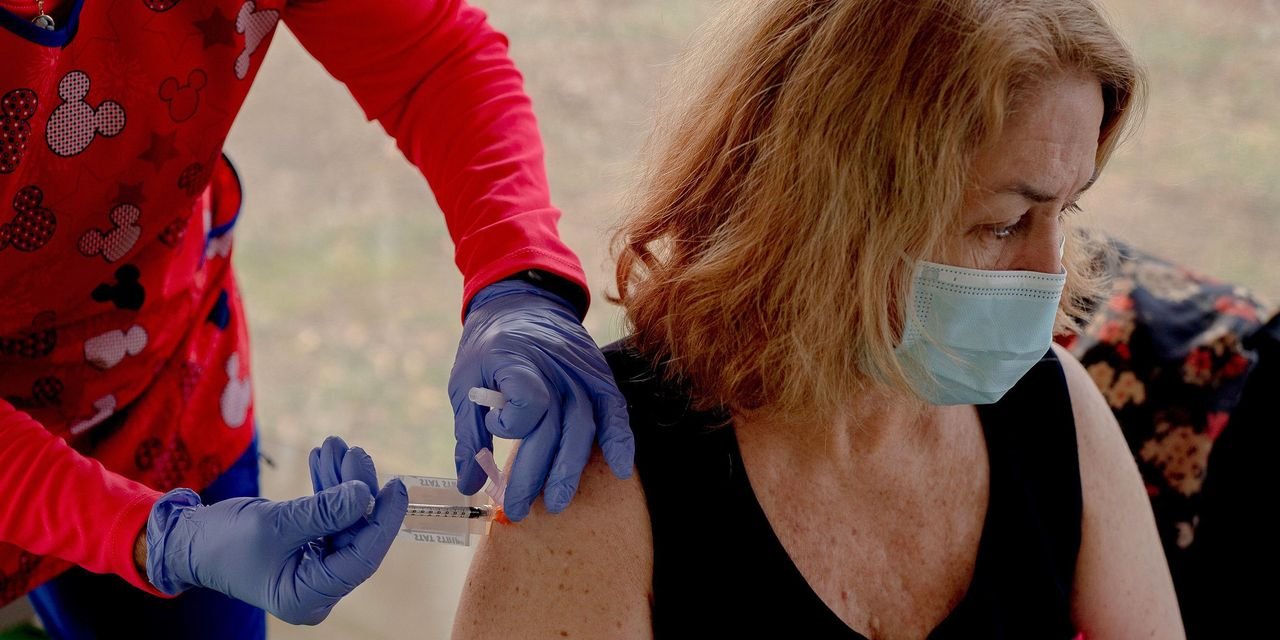
Administration officials saw the ramping up of vaccines early on in the Biden presidency as pivotal for curbing the spread of the virus.

Officials overestimated their ability to push vaccinations via incentives and mandates. A Covid-19 vaccination site in Oxford, Ala.
Photo:
Andi Rice for The Wall Street Journal
The administration moved swiftly to set up mass vaccination sites across the country, deployed the National Guard to assist with administering shots and used the Defense Production Act to accelerate the production of vaccines. Amid soaring demand, the U.S. administered 200 million shots in Mr. Biden’s first 100 days in office.
The president also expanded access to testing, extended a mask mandate on federal property and public transportation, and signed a $1.9 trillion Covid-19 relief package that included funding for vaccine distribution, help for schools to safely reopen, and money for businesses and families.
Still, the administration was overconfident that its early vaccination push would return American life to normal. The Centers for Disease Control and Prevention recommended in May that fully vaccinated people no longer needed to wear masks in most settings—but research indicated vaccinated people could transmit the Delta variant, and the guidance was reversed.
Schools in some places were also slow to reopen, despite giving priority to teachers for vaccines. Republicans accused Mr. Biden of giving into pressure from teachers’ unions. The president said it was important for schools to reopen safely, though some schools said they needed more guidance. By the fall, most schools were back in person, but fights over how they should operate continued.
The vaccination rate also stalled despite a monthslong persuasion campaign by the White House.
“The thing that we know, and we knew it from Day One, was that vaccinations were our most effective tool,” said
Jeffrey Zients,
the White House Covid-19 coordinator. “Throughout this effort, we’ve been a little taken aback at times by the political resistance, the misinformation, to getting people vaccinated.”
For months, the administration rejected pursuing vaccine mandates or requirements. But as Delta triggered an increase in hospitalization and death rates among unvaccinated people, Mr. Biden felt there was no longer a choice.
On Labor Day weekend, Mr. Zients said, he spoke to the president about mandating vaccines. Mr. Biden said that while he had hoped requiring vaccines wouldn’t be necessary, the administration had exhausted its other options.

Administration officials saw the ramping up of vaccines early on in the Biden presidency as pivotal. A nurse prepares Covid-19 vaccines at a pop-up clinic in Oakland, Calif.
Photo:
Constanza Hevia H. for The Wall Street Journal
Under the rules, all employers with 100 or more employees would have to require that their workers be vaccinated or tested weekly. Mr. Biden also mandated Covid-19 vaccines for federal workers and contractors. The Supreme Court later dealt the effort a blow, blocking the rules for private employers, though it upheld a requirement for many health workers. Lower courts have blocked mandates for federal workers and contractors, and legal proceedings are ongoing.
Administration officials say the Omicron variant’s impact on the U.S. would have been worse if not for another controversial vaccination decision. Top U.S. health officials backed a booster plan in August after data from Israel showed the shot’s waning efficacy among vaccinated people—just a month after the CDC had said boosters weren’t needed.
“‘The administration clearly had a strategy that emphasized vaccines, and I think we should recognize that they’ve achieved a fairly remarkable public-health feat in terms of getting a large number of Americans vaccinated.’ ”
The move didn’t sit well with some at the FDA. Some officials felt the administration had put pressure on regulators to endorse boosters, and it prompted two top career scientists to leave the agency. In addition, public-health advocates said variants would emerge if the U.S. didn’t share more vaccines with low-income countries. Wealthy countries have received a disproportionate share of doses. The Biden administration committed to donating 1.1 billion doses overseas, more than any other country.
Administration officials say the booster decision likely saved American lives and prevented more serious infections. Vaccines and booster shots offer superior protection from the Delta and Omicron variants, according to three studies recently released by the CDC.
The administration stopped short of taking other big steps before the Omicron variant surged.

The White House says controlling Covid-19 is a long-term task. A nurse administers a booster vaccine at a clinic in White Plains, N.Y.
Photo:
Desiree Rios for The Wall Street Journal
The White House in the fall rejected the idea of sending rapid Covid-19 tests to all Americans, an approach taken by many countries in Europe. The administration was reluctant to embrace the idea based on its cost and the potential that many tests would go to waste, according to people familiar with the discussions.
But as Omicron spread around the Christmas holidays, the test shortage meant people who were asymptomatic or had mild symptoms were unable to confirm if they had the virus and expanded the risk of passing it onto others. In January, the administration said it was requiring private insurers to cover the cost of over-the-counter Covid-19 tests and launching a website where people can request that free at-home rapid tests be mailed to them.
SHARE YOUR THOUGHTS
How do you think the government’s pandemic response will differ moving forward? Join the conversation below.
“If we had that a month ago, that would have been better,” said
Anthony Fauci,
the president’s chief medical adviser. “It would have been really nice if it were there in November.”
The administration also was surprised by how quickly the variant hobbled the operations of schools and businesses, and struggled to establish guidelines to help them stay open.
The CDC on Dec. 27 cut in half the time infected persons need to isolate, as long as they didn’t have symptoms or their symptoms had improved, but drew widespread criticism for not requiring that people test before leaving isolation. Days later, the CDC added new guidance on voluntary testing but stopped short of recommending people get tested.

President Biden expanded access to testing. A Covid-19 testing site in New York.
Photo:
Thalia Juarez for The Wall Street Journal
The White House says controlling Covid-19 is a long-term task. It will require developing variant-specific vaccines, further scaling up access to testing and therapeutics while making other personal protective equipment more readily available.
The administration recently doubled its order of
Pfizer Inc.’s
Covid-19 antiviral pill and announced plans to distribute 400 million free N95 masks at local pharmacies and community-health centers across the country.
But officials say some form of the virus will remain for the foreseeable future.
“As long as it’s circulating, there is a threat of yet another variant,” Dr. Fauci said. “Worst-case scenario is the next variant comes in, and it knocks us for a loop again.”
Write to Sabrina Siddiqui at Sabrina.Siddiqui@wsj.com and Stephanie Armour at stephanie.armour@wsj.com
Copyright ©2022 Dow Jones & Company, Inc. All Rights Reserved. 87990cbe856818d5eddac44c7b1cdeb8
[ad_2]
Source link