[ad_1]
The U.S. is headed for a surge in economic activity over the late winter and early spring as the Omicron variant wanes and Americans across the country—many armed with either triple or quadruple vaccinations or heightened immunity due to infection—return to offices, schools, and in-person leisure activities.
The rush back to normalcy is likely to be reminiscent of the country’s first two reopenings—in summer 2020, after the initial series of lockdowns lifted, and spring 2021, after widespread vaccinations and another round of stimulus checks fueled fresh confidence among Americans. Consumer spending on services jumped 9.1% between the second and third quarters of 2020 and 4% between the first and second quarters of 2021.
The question with Reopening 3.0, however, is whether the services sector will be able to support it—and what it means for the economy, and especially for inflation, if demand returns faster than supply. The pressure could be particularly strong on the hard-hit leisure and hospitality sector, where employment remains down 1.2 million jobs from February 2020 levels.
“People are going to be eager,” says Tom Simons, an economist at Jefferies. “It’s not going to be a demand problem. … The issue is more on the fact that a lot of places are so severely short-staffed, it’s going to be hard to meet all of that demand.”
More Must-reads on the Labor Shortage
The hope with this reopening, economists say, is that consumers start to feel an enduring confidence in their own safety, in turn sparking a protracted period of growth. Millions of Americans who have just been infected with the Omicron variant will be carrying extra protection against the virus, at least temporarily. New cases continue to be mostly mild, data show, especially for vaccinated people. Children ages 5 and above are now eligible for vaccines. The medical community is talking about a not-too-far-off transition from “pandemic” to “endemic,” where the disease becomes a routine public health concern much like influenza.
Americans themselves are expecting a ramp-up in economic activity, too. Consumers on average expect their household spending to rise 4.6% over the next year, according to a New York Fed Survey of Consumer Expectations released Monday. That marks the highest level of median expectations since the series began in 2015.
The post-Omicron economic surge might not be quite as pronounced as last summer’s, given the lack of fresh fiscal stimulus from Washington and the fact that the Omicron slowdown was more muted than those of previous waves to begin with. But the perception of a pandemic lull could still have a significant effect. “People are going to, I think, have an even more euphoric attitude toward this if we do feel like this is really the actual end of the pandemic,” Simons says. “That will feel like a boom.”
That means a potentially dramatic shift in spending away from goods, where demand has been red hot for the better part of two years, and toward services, one sector of the economy where recovery has been stunted.
While goods spending is 20% above its pre-Covid baseline, services spending remains 5% below that level, according to Tom Porcelli, chief U.S. economist at RBC Capital Markets. “That’s a staggering dispersion for a services-dominated economy,” Porcelli says.
The transition will be fueled further, too, by the excess cash consumers have saved up. While the personal savings rate has slowed back to its prepandemic normal, middle-income consumers—those in the second, third and fourth quintiles—are sitting on roughly $1 trillion more in liquid assets than they were before the pandemic, by Porcelli’s estimate.
Given how much cash is available and how depressed services spending has been for so long, the potential for growth is significant. But spending can only grow by as much as services industries can support. And the risk is that the swing back to services spending could come faster than a battered industry, strained by rising prices and persistent labor shortages, can get ready for it.
“Certainly there could be a timing mismatch if demand for those services comes roaring back in a way that the supply side is not anticipating, and they’re a step behind in responding to that,” says Ryan Severino, chief economist at JLL.
A waning of the pandemic is expected to ease the labor shortage somewhat, as fewer people stay on the sidelines out of fear of the virus and schools and childcare centers return to regular schedules, lightening the burden for parents. But that transition will take time, and tightness in the labor market is expected to persist even beyond that, economists say.
Recent data and surveys make clear that businesses are already having trouble hiring and retaining the staff they need even before a fresh surge in demand. More than 10 million jobs remained open in November, and the quits rate was at a record high 3%, Labor Department data show. Around 97% of small businesses that are hiring said labor shortages were hitting their bottom lines, according to a
Goldman Sachs
survey released Monday.
And some hotels that cater primarily to business travel are already capping capacity at 70% of rooms filled simply because they don’t have the staff to clean and manage the remaining 30%, says Patrick Scholes, a lodging and leisure analyst with Truist Securities.
The concern is that a burst of demand on an already strained services sector will exacerbate price increases and inflationary pressures, as businesses hike wages to attract workers and raise prices to cover the costs of additional labor and more expensive goods. That could continue to drive core inflation even higher, even as the cost of goods is expected to moderate due to a combination of softening demand and an easing of supply chain backlogs.
“You’re putting a floor underneath inflation because of continued tight labor markets,” Porcelli says. “And I think that’s an idea that’s being underappreciated.”
Some of those pricing pressures on services are already showing up in the data. Food away from home, for example, which covers dining at restaurants, is up 6% over the 12 months ending in December, the largest annual increase since 1982. “We are absolutely seeing restaurants increase prices more rapidly than certainly any time in my recollection,” says Sara Senatore, a senior research analyst at Bank of America. “What we have seen is much bigger price increases to cover the combination of higher input costs and higher wage inflation.”

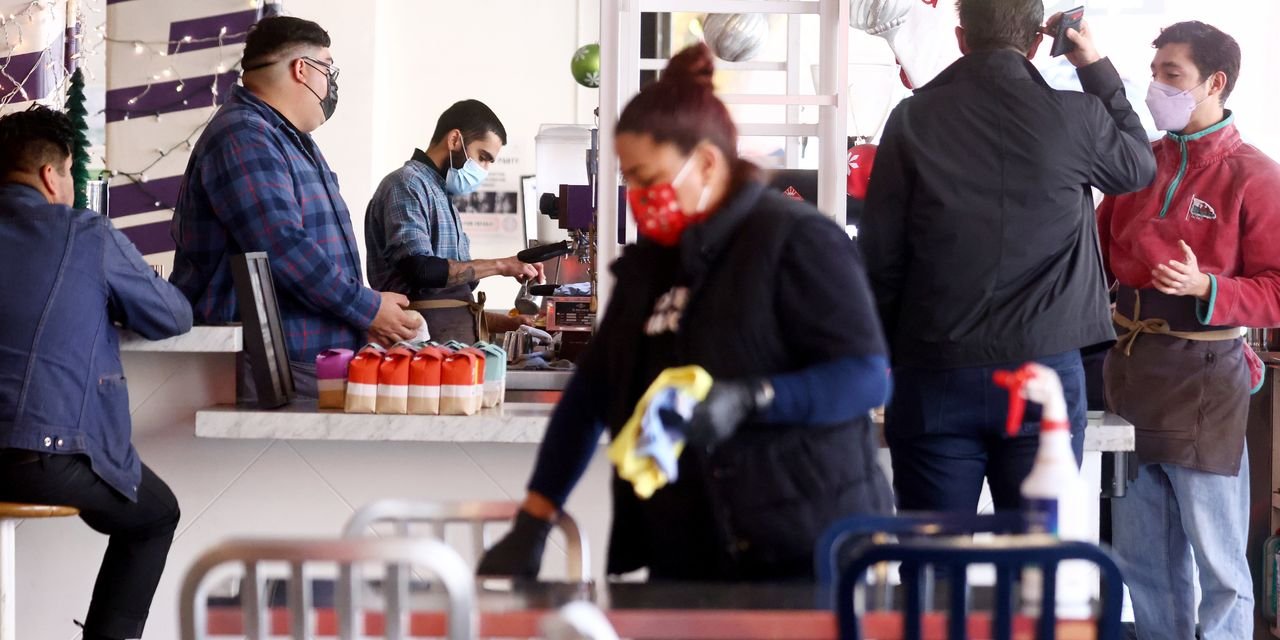
Face masks were prevalent on the streets and shopping districts in California during Reopening 2.0 this past summer.
Frederic J. Brown/AFP/Getty Images
But Senatore sees room for consumer spending to grow at restaurants, noting that people have seen their incomes rise and are still not spending as much money dining out as they would like to. That means the potential for further price increases, too, as diners return and restaurants race to staff up to be able to serve them.
Hotels could face similar issues as they gear up for a summer of leisure travel “well above” 2019 levels and possibly on par with 2021, according to Scholes’ forecasts. But labor shortages are even more of an issue now in the industry than they were a year ago, the Truist analyst said—and when hotel operators can’t staff up in order to fill their rooms, some are already raising their rates in an attempt to offset the difference. Hotel prices, for example, rose 1.3% last month and are up 27.6% over the year ending in December, Labor Department data show.
The dynamic could derail economists’ expectations—and policy makers’ hopes—that a return to more normal levels of goods and services spending would relieve pressure on supply chains and allow inflation to slow significantly later this year. Consumers may well shift their behavior—but the swing could be so rapid and significant that the same supply issues that have been driving goods inflation start driving up services prices instead.
“The issue of demand and capacity is really the biggest in the economy right now,” Simons said. “Demand is going to remain—I see absolutely no reason why it should slow down at least through the end of 2022, and probably beyond. It’s just a question of how fast can capacity come back on.”
Write to Megan Cassella at megan.cassella@dowjones.com
[ad_2]
Source link