[ad_1]
A PCR test might say you’re positive for coronavirus for three or four weeks after you’ve recovered because it’s still “picking up past infection and the small fragments (of the virus) are still being amplified,” said CNN Medical Analyst Dr. Leana Wen, an emergency physician and visiting professor of health policy and management at the George Washington University Milken Institute School of Public Health. After seven to 10 days, “that PCR test is not an appropriate test.”
Regardless of your situation, here’s what you need to know about the differences between PCR and antigen tests and when you should use them.
When a PCR test is key
The prime time to take a PCR test is when you have had a known or suspected exposure to someone with Covid-19 or are experiencing symptoms, and you want to find out if you have a coronavirus infection, said Dr. Albert Ko, the Raj and Indra Nooyi Professor of Public Health at the Yale School of Public Health.
Knowing your Covid-19 status as early in an infection as possible can help you figure out whether you’re infectious to other people, what to tell recent close contacts for their own safety, and what to share with your doctor so they can talk with you about your symptoms and prescribe any medical care if needed, said Emily Somers, an epidemiologist who holds professorships in internal medicine, environmental health sciences, and obstetrics and gynecology at the University of Michigan’s schools of medicine and public health.

That’s important because “up to two days before symptoms, or the one day or two days after symptoms (begin) people can have the highest risk of infecting others,” Ko said. When people are first exposed, it takes time for the virus to replicate enough for a test to pick up on it, Ko explained. PCR tests detect it earlier in the course of infection after exposure than the less sensitive rapid antigen test, which works by detecting a specific protein on one of the coronavirus’ spikes.
When rapid antigen tests are crucial
Contrary to what some still think is best, a rapid antigen test is what you should be taking after you have had Covid-19 for several days and want to confirm you’re probably no longer infectious to other people. “‘Infected’ means that I have the virus in me,” Ko explained. “‘Infectious’ means that I’m shedding enough virus to infect somebody else, and that only occurs during a peak. It follows a curve after someone has been exposed.”

“Even though the rapid (antigen) test has low sensitivity and is inferior to the PCR test to tell you if you’ve been infected, because of its lower sensitivity, it picks up only viruses at a higher level and probably levels that are more infectious,” Ko explained.
“At this point, we don’t have an FDA-cleared test that can tell us exactly” how much virus is needed to be infectious to other people, Ko added. But evolving evidence has led public health experts to think that rapid tests do better than PCR tests at capturing when people are exiting the period of maximum infectiousness, since PCR tests are too sensitive, he said.
“Having the presence of two rapid tests — two days in a row — that are both negative is a very good indicator a person is no longer infectious,” Somers said.
This doesn’t mean that being contagious at this point is totally impossible — it just means that once you have had Covid-19 for several days and then test negative with a rapid antigen test, the viral RNA is likely at levels low enough to not be infectious (even if you still test positive on a PCR test).
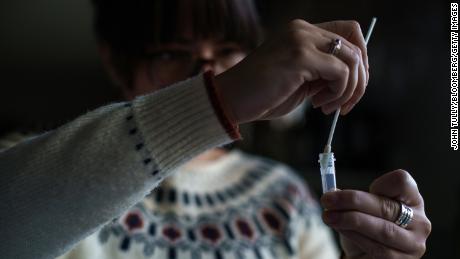
There have been many online reports of employers requiring people to show proof of a negative PCR test before they return to work, which is “probably not coherent thinking” and has people not returning to work until weeks after their initial rapid antigen or PCR test, Ko said.
“I would highly urge individuals to contact their HR (human resources department) — or if there’s a medical or Covid lead on their teams — and escalate the issue because it’s not reasonable,” Wen said.
In addition to being more convenient, the most logical return-to-work testing strategy is using rapid antigen tests, Ko said.
“Just as with any test for anything, if you use it for the wrong purpose, you’re going to get an inappropriate result,” Wen added. However, “if somebody has had multiple antigen tests that are negative, but they have symptoms of Covid, having a PCR test can help to confirm if they have it or not.”
“For the issue of somebody who had an infection and is recovering, I think this is where it’s really an administrative decision in terms of how much risk the country is willing to take (or) how much margin of error,” she added. “If a country is trying to be extremely strict in terms of keeping out all infections, then having a negative PCR will be a more sure way of doing that. However, it’s going to potentially prolong the amount of time between when somebody can enter the country compared to when they were infectious.”
CNN’s Kaitlan Collins, John Bonifield, Nikki Carvajal, Eric Levenson and Arman Azad contributed to this story.
[ad_2]
Source link